


NEWS
2017.11.28 / EVENT
Next-Generation Career Building Special Discussion|Project Company × Takagi Building

|What is a Next-Generation Career Advancement Building?
This initiative supports tenant companies’ growth by reducing the initial costs associated with office relocation during corporate expansion, allowing them to invest their available funds into business growth.Driven by the desire to create auspicious buildings where many tenants thrive and to be a business partner that grows alongside tenant companies as a real estate firm, we are pursuing this project to promote corporate growth support.
The Next-Generation Success Building initiative enhances a building’s value not only through its physical aspects like structure and facilities but also through its soft aspects, such as understanding tenant needs.
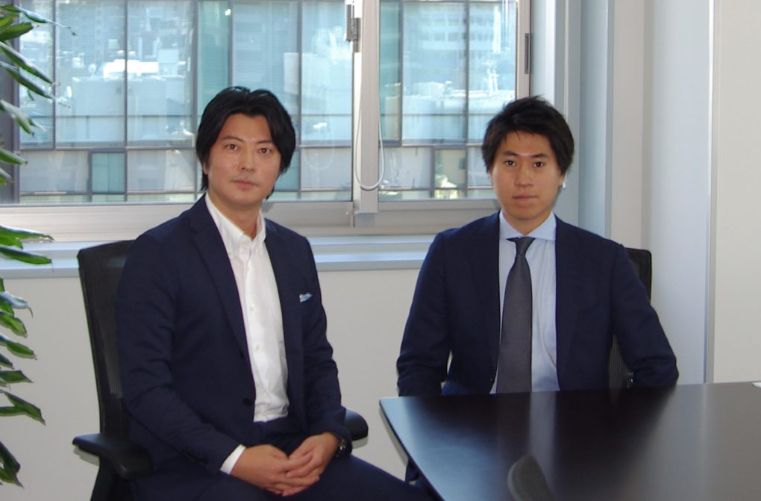
We present a dialogue interview (conducted in 2017) between Project Company, which utilized the Next-Generation Success Building Project support services and moved into Toranomon Takagi Building, and our company.
Interview | Project Company × Takagi Building
| Reasons for Moving into a Next-Generation Career Advancement Building
— You utilized the Next-Generation Career Advancement Building Project support services and moved into Toranomon Takagi Building. What were your impressions of this project’s approach of “reducing the initial costs associated with relocation and reinvesting those savings into business growth”?
Doi: I thought it was a truly helpful project. Even though our sales are growing, venture companies like ours don’t necessarily have abundant cash on hand. Paying a year’s worth of security deposit posed a significant cash flow challenge. We wanted to move into a good building to grow our business, and encountering this project allowed us to move into the building we desired.
— How did you utilize the savings from this project?
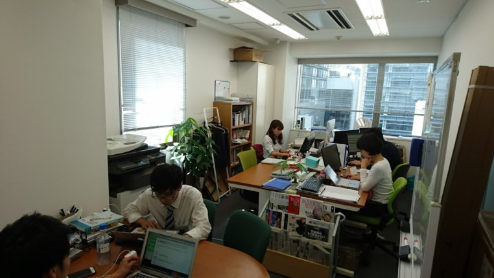
Doi: We didn’t invest it directly into the business itself. Instead, we used it for hiring and expanding our intern program. Before the move, our space was about one-fifth of what it is now. Having more space has definitely made it easier to recruit people.
— Could you briefly explain the outline of this project?
Takagi: Project Company utilized our support services for the Next-Generation Advancement Building Project. This project brings together tenant support companies to provide various services, aiming to help tenant companies advance and grow.
A key pillar is converting the security deposit required upon move-in into a guarantee contract. Tenants can move in paying only half the security deposit, which typically covers about one year’s rent. Additionally, Cycle Office is a support service offered by Takagi Building, and this project became our first implementation. Cycle Office is a service where the building provides certain equipment, wiring, and partitions free of charge, thereby reducing the initial costs for tenants moving in. While other services were also utilized, broadly speaking, these two were the main services used.
— Regarding Cycle Office, which involves lending partitions and wiring, what exactly does it entail?
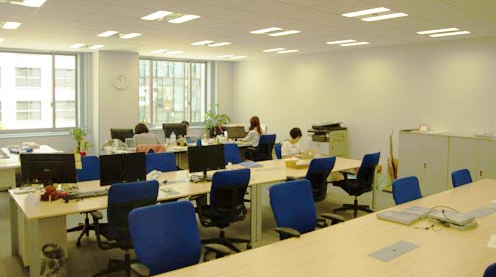
Takagi: Visually, the office appearance remains completely unchanged. Traditionally, tenants purchase, install, and customize the partitions, wiring, and fire safety equipment upon moving in.
However, in this case, Takagi Building lends the tenant the partitions, wiring, and related equipment it owns. While using equipment might bring to mind a turnkey office, Cycle Office is not a turnkey solution. The items available for rental are those with a certain degree of flexibility, such as individual partition panels or power strips for wiring. These are not items that become unusable after just 2-3 years of use. However, the traditional cycle required tenants to purchase them and then pay for their removal and disposal upon vacating. In contrast, Cycle Office is a service where tenants return the basic equipment upon vacating, and it is then rented out again for use by the next tenant.
— This approach reduces tenant costs and promotes resource efficiency. Considering the cost-effectiveness, what motivated you to launch this initiative?
Takagi: The equipment cost for Cycle Office is roughly equivalent to one month’s rent. This means tenants gain a benefit equivalent to one month’s rent. For example, even if the benefit is the same one-month value, we believe offering valuable office equipment through Cycle Office is more beneficial than adding an extra month of free rent during lease negotiations. For tenants, it’s still equivalent to one month’s benefit, but with Cycle Office, it represents a net increase in equipment for one month. On the other hand, with a free rent period, the revenue is zero, so there’s also an accounting benefit. Furthermore, while it represents a one-month cost at this point, when the current tenant vacates, we can simply lease the same equipment to the next tenant.
This seems like a win-win service, beneficial for both us and the tenants. For future move-out cycles, rather than paying tenants to dispose of items, we are also considering taking them back at no cost.The Cycle Office concept. Equipment like wiring and partitions will be passed on to the next tenant.
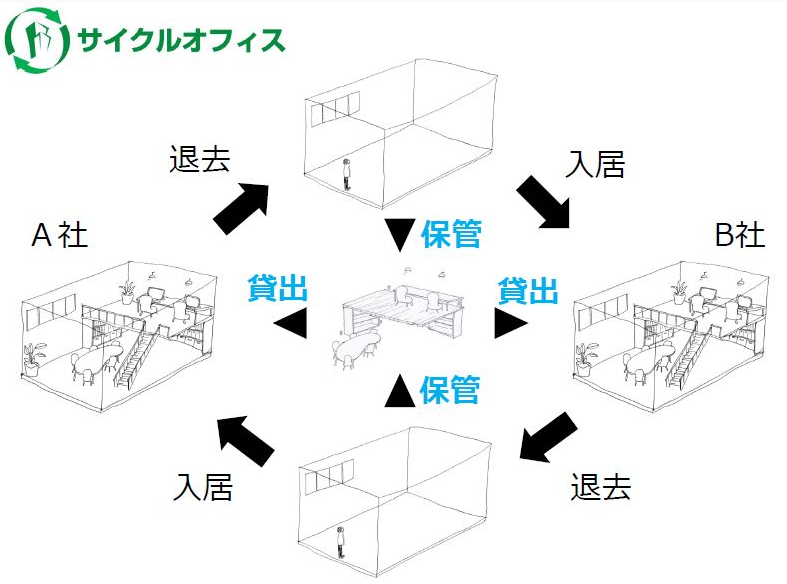
will be passed on to the next tenant.
ー Project Company utilized various services this time, including Deposit Halver-kun (※Service name at time of interview. Now “Deposit Halver-kun”), Cycle Office, and others. Were there any other services you wished existed?
Doi: Honestly, it was truly comprehensive. We were also introduced to a partnered credit union, which provided us with a 5 million yen loan. We have aspirations to grow within this next-generation career-advancement building, the Toranomon Takagi Building. If possible, we would like to expand our space within this building.
— When deciding to relocate, what were the key factors in choosing the building, including its location?
Doi: The building’s inherent reliability was key, along with proximity to Tokyo and Akasaka, where many of our clients are based. We chose Toranomon specifically because it’s a long-established business district with many professionals like accountants, yet it’s also undergoing development and poised to become even more vibrant. It’s a location that respects tradition while embracing innovation, which aligns well with our company culture.
— What kind of office facilities and services do you think are necessary to work comfortably while occupying the space?
Doi: Cleanliness and a sense of solidity, I suppose. An environment that makes you think, “I want to work here,” is crucial. Key indicators are whether it’s an environment you’d want to bring clients to and whether employees can work with high motivation. In that regard, the Toranomon Takagi Building has a sparkling entrance, making it pleasant to start each day. It’s clean, and we can work daily with peace of mind and high motivation. I don’t think being overly flashy or trying too hard to project luxury suits business. Considering working there for several years, that approach seems unsustainable.
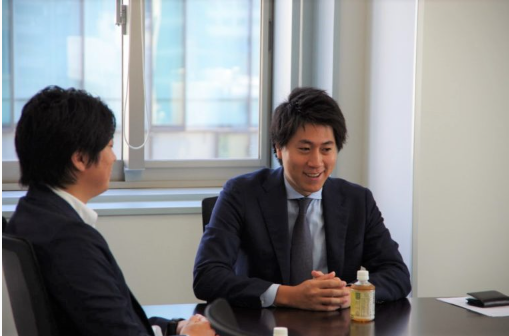
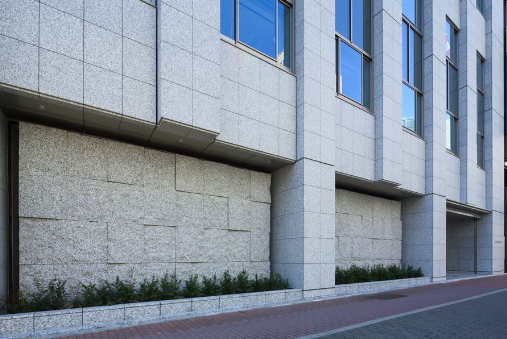
Takagi:The current trend is toward glass buildings. When rebuilding this Toranomon Takagi Building, we deliberately chose stone construction. We aim to operate a building that will last a century, and since stone doesn’t fade, I believe it will develop more character over time. People tend to find natural materials somehow comforting, don’t they? Facing the historic Sotobori-dori street, we also wanted to use stone to evoke the “image of a moat,” as the name suggests. It also reflects my personal feelings about the Toranomon area.
Furthermore, creating protruding sections from the exterior is the secret to its substantial feel. Actually, eliminating these protrusions would allow for larger rooms. However, that would make the exterior look flat and featureless. Rather than focusing on increasing office space by a few square meters, I prioritized adding value through the building’s substantial presence and sense of importance. I believe it has become a building that will be cherished for a long time.
ー Considering trends in the building industry, how do you think the criteria for selecting buildings will evolve in the future?
Takagi: Development is progressing in Toranomon, with scrap-and-build projects underway. Major developments are also planned, and it’s said that office space alone will increase by tens of thousands of square meters in this area alone.
While this brings vitality, I anticipate polarization will also advance. I believe the lifeline will be how we can build the branding for these buildings. Within that context, we created projects like the Next-Generation Career Advancement Building Project and Cycle Office. We shifted our focus to becoming business partners with our tenants, seeing things from their perspective.
In building management, rent is the revenue source. But focusing solely on rent can sometimes lead to a disconnect between maintaining value and what building management truly requires. For mid-sized buildings, competing with large players based on hardware and specs alone is impossible. Building management needs that closeness to understand tenant needs – something large players struggle with.
Traditionally, building management often meant merely owning the property. We must break free from this mindset to avoid becoming obsolete. I believe we will cease to be chosen unless we actively communicate our vision and the value we offer as owners.
— This project emphasized shifting from the traditional landlord-tenant relationship to viewing tenants as business partners for mutual growth. What was the intent behind this?
Takagi: This also stems from our reflection as building managers. In the past, it was even said that tenants and landlords shouldn’t meet. The reasoning was that having a management company or intermediary involved was better in case of disputes. While that approach has its merits, it inevitably creates distance between us and our tenants. We lose touch with their desires, frustrations, and satisfaction levels. In most businesses, distancing yourself from users is unthinkable, yet in the leasing business, it was often advised to have intermediaries. While it’s a lease agreement, building owners and tenants need to recognize they are business partners. It’s easy to think building management ends with tenant acquisition, but I believe the real building management begins afterward.
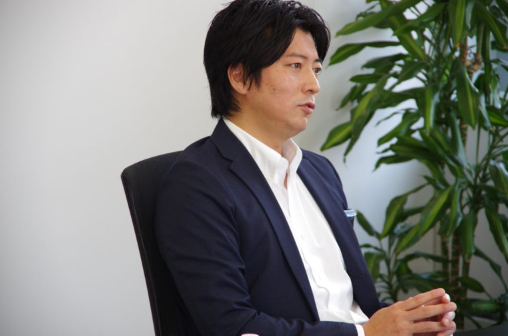
— One major goal of this project is mutual growth with growing companies as business partners. If there are ways the project company could grow together with this project, please let us know.
Doi: I want to spread the word to fellow executives of my generation that such a comprehensive project exists. I also aspire for us to become the most successful tenant within the Shusse Building Project as we grow.
Takagi: Currently, we have tenants in over 20 buildings. We believe that as this number grows, the barriers to relocation will decrease. We envision tenants moving between buildings within the next-generation Success Building network and collaborating on building-level management and operations across different areas and services. For example, providing free coworking spaces for tenants within the Career Advancement Building Project would be ideal. We aim to offer new usage models that transcend the constraints of existing leases and individual building limitations.
— Finally, could you tell us straight up about Project Company’s future growth plans?
Doi: Since our founding, we’ve had the goal of becoming a trillion-yen company by 2045. We constantly strive towards this. In the short term, our targets are 2 billion yen in sales by 2020 and going public in 2021. We plan to grow nearly threefold from our first year of operation to this year. We intend to keep growing like this and become the top performer among the Shusse Buildings.
— Please tell us exactly where you are aiming to go by launching this project to the world.
Takagi: In a word, it boils down to “revitalizing Japan.” That includes the economy, business leaders, and the working population. This project is the tangible outcome of unraveling and giving back to that grand vision!
| Free Talk After the Interview
Takagi: Going public in 2021 is an excellent goal.
Doi: We are absolutely determined to make it happen.
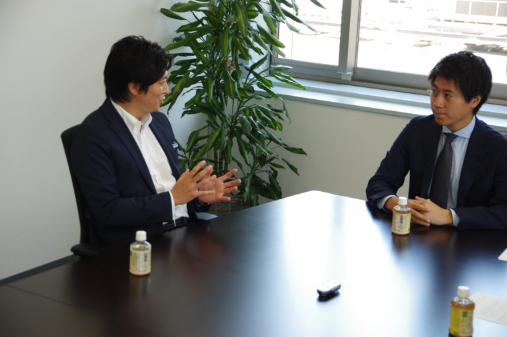
Takagi: What is the key to growth, the biggest challenge?
Doi: Regarding challenges, we’re already effective at delivering results on a project-by-project basis. I’m confident we can continue growing steadily like this. However, when considering our grand vision, the crucial point will be how well we can unite and align our efforts. The challenge lies in how we’ll shape our future value proposition.
Takagi: How about talent acquisition?
Doi: Until now, we’ve focused on mid-career hires and interns. Starting next year, we’ll begin hiring new graduates. We aim to build an organizational structure that aligns with our company’s culture. Recruitment is progressing smoothly, as our branding has become relatively established. Being a company founded by University of Tokyo alumni, we attract quite a few juniors. However, we haven’t hired our first new graduate outside our existing network, so next year’s graduate recruitment is key.
Takagi: What is your vision?
Doi: The core idea is to create a society where work is project-based. We want to revitalize Japan. As more people become capable of working on individual projects, and as more talent thrives in such projects, Japan’s energy level will rise. Ultimately, we believe this will lead to a revitalized Japan. We want to foster revitalization by creating opportunities for diverse people to participate.
Takagi: Speaking of revitalization, regional areas are a challenge, right? We also hope to eventually spread the Next-Generation Advancement Building Project to regions across Japan. While work-style reform is a hot topic these days, if project-based opportunities like those Project Company describes become available, I believe Japan’s untapped talent pool could work from anywhere. If the traditional model of working in downtown office buildings can be extended to regional areas through the advancement of IT systems, wouldn’t that become a key to regional revitalization? I believe it would be exciting for us in the private sector to propose such new ways of working. We sincerely hope Project Company will help revitalize Japan!
■Company Profile
Project Company Inc.
URL: https://projectcompany.co.jp
Takagi Building Co., Ltd.
URL:https://t-bldg.jp